Commercial Auto
The Florida Contractor's Guide to Commercial Auto Insurance
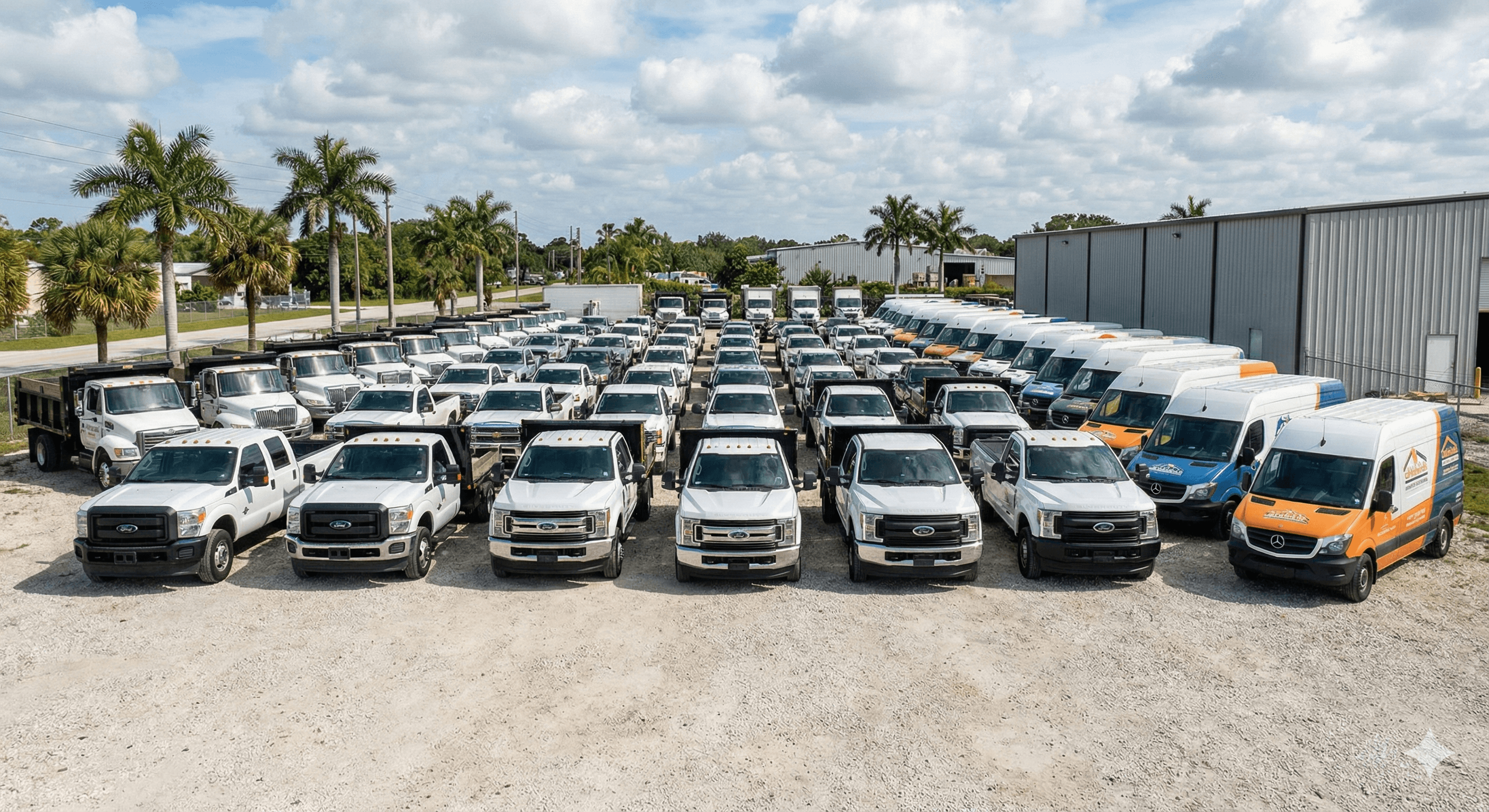
Every contractor who's been around long enough has a story: the dump truck that got T-boned by an uninsured driver on US-1, the rental van that got sideswiped and suddenly the rental company wants $15,000, or the superintendent's personal truck that caused a wreck on the way to a job site - and now everyone's pointing fingers at who's supposed to pay. Commercial auto insurance isn't just about covering your trucks. It's about understanding how all the pieces fit together - your vehicles, your employees' vehicles, your rentals, your trailers, and the equipment you're hauling - so you don't get blindsided when something goes wrong.
Here's the reality for Florida contractors: you're operating in one of the most dangerous driving environments in the country, with some of the highest uninsured driver rates, hurricane exposure that can wipe out an entire fleet overnight, and a liability environment that makes adequate coverage non-negotiable. The contractors who get this right sleep better at night. The ones who don't? They find out the hard way that the cheapest policy isn't always the best deal.
This guide breaks down everything Florida builders and trade contractors need to know about Business Auto Policies - from the symbol system that determines what's actually covered, to the Florida-specific traps that catch contractors off guard, to the insider strategies that can save you thousands while actually improving your protection.
Quick Reference: What Florida Contractors Need to Know
Topic
What You Need to Keep in Mind
Florida minimums
State requires only $10,000/$20,000/$10,000 - dangerously inadequate for any real contractor operation
Uninsured motorist exposure
Florida has 20-25% uninsured drivers - among the highest in the nation. UM coverage protects YOU, not the other guy
The symbol system
Symbols 1-9 determine what vehicles are covered. Wrong symbols = dangerous gaps you won't discover until a claim
Hired & non-owned auto
When employees use personal vehicles or you rent equipment, you've got exposure. Symbols 8 and 9 address this
Mobile equipment vs. auto
Critical distinction - CGL covers mobile equipment liability, BAP covers autos. Get it wrong and neither policy responds
Subcontractor verification
If your sub causes an accident and they're uninsured, claims flow uphill to you
Physical damage traps
"Stated Amount" caps your payout without guaranteeing value. Hurricane season makes comprehensive coverage essential
Trailer contents
BAP covers the trailer - NOT what's inside. Your $50,000 in tools needs separate inland marine coverage
Cost of hire audits
No Symbol 8 on your auto policy? Your GL auditor may pick up rental costs and charge you a much higher rate
The bottom line: Commercial auto is more complex than most contractors realize, and the gaps between policies - auto, GL, workers' comp, and equipment floaters - are exactly where claims fall through.
Florida's Auto Insurance Requirements: The Floor, Not the Ceiling
Florida's Financial Responsibility Law (Chapter 324, Florida Statutes) sets minimum liability requirements that are, frankly, a joke for any contractor running a real operation. The state requires just $10,000 per person / $20,000 per accident for bodily injury and $10,000 for property damage. Those limits would be exhausted in virtually any accident involving actual injuries.
Here's a Florida-specific wrinkle that matters for contractors with heavier trucks: while standard personal vehicles must carry $10,000 in PIP (Personal Injury Protection) coverage, commercial trucks over 10,000 pounds GVWR are generally exempt from mandatory PIP under Florida Statute § 627.732. That means most contractor dump trucks, service vehicles, and equipment haulers don't have that first-party medical protection. If your driver gets hurt in an accident that's their fault, there's no PIP to fall back on - which makes your liability coverage and uninsured motorist coverage even more critical.
For contractors doing certain types of hauling, federal requirements kick in on top of Florida's rules. Vehicles over 10,001 pounds GVWR operating commercially need a USDOT number. If you're hauling goods for compensation across state lines, FMCSA minimums jump to $750,000 for non-hazardous freight and up to $5 million for hazardous materials. These federal requirements apply regardless of what Florida says, and they typically require filing an MCS-90 endorsement with the FMCSA.
The CDL threshold matters too: vehicles over 26,001 pounds GVWR require CDL-licensed drivers. If you're running heavy dump trucks, concrete mixers, or equipment haulers, make sure your drivers have proper credentials and your policy doesn't quietly exclude CDL-required operations.
The Symbol System: Where Most Contractors Get Lost
The ISO Business Auto Coverage Form uses a symbol system (1-9) that determines which vehicles are covered under each type of coverage. This isn't just insurance jargon - getting the wrong symbols on your policy creates gaps that won't show up until you file a claim and get denied.
Symbol 1 (Any Auto) is the broadest coverage available. It covers all owned autos, hired autos, non-owned autos, and newly acquired vehicles automatically. For contractors with changing fleets, frequent rentals, and employees who sometimes use personal vehicles for business, Symbol 1 eliminates most coverage gaps. It costs more, but it also means you're not playing gotcha games with your coverage.
Symbols 2, 3, and 4 narrow things down for owned vehicles. Symbol 2 covers all owned autos. Symbol 3 covers only owned private passenger vehicles. Symbol 4 covers owned commercial vehicles specifically. Most contractors need Symbol 2 or Symbol 4 for their fleet, often combined with Symbols 8 and 9 for the hired and non-owned exposures.
Symbol 7 (Specifically Described Autos) is where things get risky. Coverage applies only to vehicles explicitly listed by VIN on your declarations page. The trap: newly acquired vehicles get only 30 days of automatic coverage before you need to formally add them. Buy a trailer mid-project and forget to report it? You might find out it's uninsured after it's already been stolen or wrecked.
Symbols 8 and 9 address two exposures that catch contractors off guard constantly:
- Symbol 8 (Hired Autos): Covers vehicles you rent, lease, or borrow. That dump truck you rented for the week? Symbol 8.
- Symbol 9 (Non-Owned Autos): Covers liability when employees use their personal vehicles for business. Your estimator driving their own truck to check a job site? Symbol 9.
Without these symbols - or Symbol 1 - you've got serious gaps in coverage.
Symbol 19 is one most contractors have never heard of, but it matters for certain equipment. Mobile equipment (like a mobile crane) is normally covered under your CGL, not your auto policy. But if Florida requires that crane to have a license plate and registration to drive on public roads, it triggers the Financial Responsibility Law - and your CGL won't satisfy that requirement. Symbol 19 bridges this gap for mobile equipment that needs a tag.
Mobile Equipment vs. Auto: The Distinction That Determines Everything
One of the most consequential classifications in contractor insurance is whether a piece of equipment qualifies as "mobile equipment" or an "auto." This determines whether your CGL or your BAP provides liability coverage - and getting it wrong can leave you completely uninsured.
Mobile equipment includes land vehicles designed primarily for purposes other than transportation. Bulldozers, backhoes, excavators, graders, forklifts, and mobile cranes generally qualify as mobile equipment. Air compressors, generators, and pumps mounted on wheels are explicitly included in the mobile equipment definition. So are cherry pickers and aerial lifts.
Your CGL policy covers liability arising from mobile equipment operation. The CGL's auto exclusion removes coverage for vehicles. Meanwhile, your BAP covers "autos" - land motor vehicles designed for travel on public roads. Pickup trucks, dump trucks designed for highway use, flatbed trucks, and concrete mixer trucks are autos regardless of what equipment they carry.
The gray areas create real coverage disputes. A bucket truck has hybrid characteristics: the truck chassis is an auto (BAP covers accidents during road travel), while the aerial lift component is mobile equipment (CGL covers liability when the lift is deployed and operating). When in doubt, make sure both CGL and BAP coverage is in place and talk to your underwriter about how specific equipment is classified.
Here's the physical damage piece that trips people up: Neither CGL nor BAP covers physical damage to mobile equipment. That requires a Contractors Equipment Floater (inland marine coverage). The BAP covers physical damage to autos only. A common mistake: assuming the BAP protects the backhoe loaded on your trailer. It doesn't. The trailer may be covered if properly scheduled as an auto, but the backhoe needs separate equipment floater coverage.
Florida's Uninsured Motorist Crisis: Protecting Yourself, Not Just Others
Here's something most commercial auto conversations miss entirely: liability coverage protects the other guy when you cause an accident. Uninsured Motorist (UM) coverage protects YOU when someone else causes one.
And in Florida, that matters more than almost anywhere else in the country.
Florida consistently ranks in the top 3 states for uninsured drivers - roughly 20-25% of drivers on the road have no coverage. That means if your superintendent is driving the company truck and gets T-boned by a drunk driver with no insurance, the question becomes: who pays his medical bills?
Without Commercial UM coverage, here's what happens: those injuries may fall entirely on your Workers' Comp policy. Your employee was in the course of employment, so WC covers it. But now you've got a major claim hitting your experience modification - potentially hiking your WC premiums for the next three years because some uninsured driver ran a red light.
UM coverage is actually an E-Mod protection strategy. It provides another source of recovery that can reduce or eliminate the hit to your workers' comp experience rating.
Florida's "Stacked" vs. "Non-Stacked" UM rules create options most contractors don't know about. By default, carriers must offer Stacked UM equal to your bodily injury limits unless you specifically sign it away. Here's why stacking matters:
If you have 10 trucks with $100,000 of Stacked UM each, you technically have access to $1,000,000 in total coverage for a catastrophic accident. Many contractors reject UM entirely to save money on premiums, but in a state where 1 in 4 drivers is uninsured, Stacked UM may be the cheapest catastrophic injury protection you can buy for yourself and your key employees.
The question to ask: "If my best foreman gets hit by an uninsured driver tomorrow and can't work for two years, how does my current coverage respond?"
Hired and Non-Owned Auto: The Gaps That Catch Everyone
Contractors face significant vicarious liability exposure when employees use vehicles for business purposes - whether company-owned, personally-owned, or rented. The legal doctrine of respondeat superior holds employers liable for negligent acts of employees performed within the scope of employment, including auto accidents.
Non-Owned Auto (Symbol 9)
When employees drive their personal vehicles for work - checking job sites, picking up materials, meeting with clients - you've got exposure. The employee's personal auto policy typically responds first as primary coverage, but your BAP with Symbol 9 provides excess coverage when their limits aren't enough.
The gap becomes critical when employees are underinsured or uninsured. If your project manager's personal policy has lapsed or carries only $25,000 limits, a serious accident generating $500,000 in damages leaves a $475,000 gap. Your non-owned auto coverage bridges that exposure - but only if Symbol 9 (or Symbol 1) is actually on your policy.
Hired Auto (Symbol 8)
Most contractors rent equipment trucks, cargo vans, or specialty vehicles for specific projects. Symbol 8 provides liability coverage for these rented vehicles.
But here's the trap: Symbol 8 covers liability only. Hired auto physical damage requires a separate endorsement (CA 99 34). Without it, damage to a rented vehicle becomes your personal responsibility - and rental companies come after these claims hard, including loss-of-use charges of $50-150 per day while the vehicle is being repaired.
The "Cost of Hire" Audit Surprise
Here's an insider angle that parallels the WC audit traps we've discussed elsewhere:
Just like Workers' Comp audits look at your payroll, your General Liability audit often looks at "Cost of Hire" for autos. If you spent $50,000 last year renting dump trucks but don't have Symbol 8 (Hired Auto) on your auto policy, the GL auditor may pick up that rental exposure and charge a much higher rate for it under your GL's Non-Owned Auto Liability.
Having Symbol 8 on your auto policy isn't just about coverage - it stops the GL auditor from adding your rental costs to your liability audit at a worse rate.
Take-Home Vehicle Exposure
When employees take company vehicles home, coverage typically extends 24/7 under the standard BAP. The complexity arises with family members: a spouse who drives the company truck with permission is likely covered as a permissive user, but coverage could be disputed if company policy prohibits family use.
Written take-home vehicle policies specifying authorized drivers, permitted uses, and geographic limitations aren't just HR paperwork - they're documentation that matters when claims get disputed.
Subcontractor Auto Insurance: What GCs Need to Verify
General contractors face derivative liability when subcontractors cause auto accidents during project work. If a sub's employee injures someone while driving to or from the job site, the GC may face claims under negligent hiring, negligent supervision, or vicarious liability theories - especially if the subcontractor is uninsured or underinsured.
What You Actually Need to See on Certificates
The ACORD 25 certificate should show:
- Covered auto symbols (preferably Symbol 1, or the combination of Symbols 2, 8, and 9)
- Liability limits meeting contract requirements (typically $1,000,000 CSL minimum for most commercial work)
- Current policy dates
- Correct named insured matching the subcontractor's legal entity
Additional Insured Status Works Differently on Auto
While additional insured endorsements are nearly universal on CGL policies, they're less common and harder to obtain on commercial auto policies. The ISO CA 20 48 (Designated Insured) or CA 99 17 (Additional Insured Where Required by Written Contract) endorsements exist, but not all carriers offer them. Request additional insured status when possible, but don't assume it's automatically included like it often is on GL.
Waiver of Subrogation (CA 04 44)
This prevents the subcontractor's insurer from suing you to recover money after paying a claim - even if you were partially at fault. The endorsement typically costs a small additional premium (2-5% of auto premium) and should be required in subcontracts alongside the equivalent GL waiver.
Verification Beyond the Certificate
Certificates are informational documents that don't guarantee coverage. They can be outdated, inaccurate, or based on policies that subsequently lapsed. For critical subcontractors:
- Confirm the insurer's A.M. Best rating (A- VII minimum recommended)
- Request copies of actual endorsements, not just certificates
- Consider verifying coverage directly with the carrier for high-risk subs
- Implement certificate tracking with automatic expiration alerts
Coverage Gaps That Catch Florida Contractors Off Guard
The Loading and Unloading Gap
Both BAP and CGL provide coverage for loading and unloading operations, which creates questions about which policy responds. Under the "complete operations" doctrine followed by most jurisdictions, loading and unloading continues until property is completely removed from the vehicle and positioned at its final resting place.
Practically, the BAP typically takes the lead on these claims, but both policies should be in place. A claim that falls between them because of policy coordination issues is a nightmare you don't want.
Trailer Coverage Gaps
Owned trailers must be specifically scheduled on the BAP or covered under Symbol 1 or 2 to receive physical damage coverage.
But here's what catches contractors: Contents of trailers - your tools, equipment, materials - are NOT covered by the BAP. A contractor whose enclosed trailer gets stolen with $50,000 in tools inside may find the BAP covers the trailer itself but nothing inside it. That's what your Inland Marine coverage is for.
Rental Vehicle Physical Damage
We've mentioned this, but it bears repeating: Symbol 8 provides liability coverage for hired autos, but physical damage coverage requires endorsement CA 99 34 or equivalent. Many contractors rent vehicles assuming their policy covers damage to the rental. It likely doesn't without this specific endorsement.
The "Stated Amount" Trap
Here's a technical issue where agents sometimes cut corners to make quotes look cheaper:
"Stated Amount" coverage caps your payout at the stated value - but it doesn't guarantee that payout. The policy typically pays the lesser of the stated amount OR actual cash value. So you're capping the maximum while still eating depreciation on the low end.
For expensive, modified rigs - like a custom welder's truck with $30,000 in permanent modifications - "Stated Amount" is a terrible deal. "Agreed Value" coverage actually guarantees the scheduled amount regardless of depreciation. It costs more, but for high-value specialty vehicles, it's the right answer.
The question to ask your current agent: "Is my physical damage on stated amount or agreed value?" If they're using stated amount to make your quote look cheaper, they're capping your payout while you still pay for depreciation.
The Hurricane Gap
Here's a Florida-specific trap: contractors often drop "Comprehensive" (Other Than Collision) coverage on older heavy trucks to save money. The logic makes sense - the truck's not worth much, why pay for comprehensive?
Then hurricane season hits. The yard floods. The truck is totaled.
In Florida, comprehensive coverage isn't about cracked windshields. It's about flood protection. If your fleet is parked in a flood zone - and in Florida, that's a lot of places - dropping comprehensive coverage is betting your business against a hurricane. The premium savings look good until you're staring at $200,000 in flooded equipment with no coverage.
Specialty Vehicle Operational Exclusions
Some policies exclude Power Take-Off (PTO) operations - meaning when a dump truck raises its bed or a concrete mixer operates its drum, coverage may not apply. Crane operations, bucket operations, and other specialty vehicle functions should be explicitly confirmed as covered, not assumed.
The "Bobtail" Gap: When You Occasionally Haul for Others
This one catches contractors who do occasional hauling work for others - maybe you're hauling dirt for a neighboring contractor, or moving equipment for a customer as part of a project.
Your standard BAP may have a "for hire" exclusion. If you're hauling under someone else's authority (their MC number), you might need Non-Trucking Liability (Bobtail) coverage. If you're hauling cargo for compensation, you might need Motor Truck Cargo coverage.
The distinction matters: are you hauling your own materials to your own job sites (standard BAP), or are you hauling someone else's stuff for money (may need specialized coverage)?
The "Tag Surrender" Hassle: Don't Cancel Mid-Season
Trying to save money by suspending insurance on a seasonal paving truck or a piece of equipment that sits all winter?
Here's what happens in Florida: if you cancel liability coverage, the DMV will suspend your registration and demand you surrender the tag immediately. This creates a hassle when you want to put that truck back in service - you'll need to re-register, get new tags, and deal with the bureaucratic nightmare.
The better approach: Ask about "Comprehensive Only" lay-up credits. You can keep the tag active, maintain physical damage coverage (protecting against theft, vandalism, weather), but stop paying for liability while the truck sits. When you're ready to put it back in service, you add liability back without the registration nightmare.
Policy Coordination: How Auto Fits With Everything Else
BAP + Umbrella/Excess Liability
Your umbrella typically sits above your BAP, CGL, and employers liability. Key coordination issues:
- Verify your umbrella lists the BAP as scheduled underlying coverage
- Most umbrellas require minimum underlying auto limits (commonly $1,000,000 CSL) and won't respond if underlying limits are inadequate
- Make sure your umbrella specifically includes commercial auto coverage for all vehicle types in your fleet, including heavy trucks and specialty vehicles
BAP + CGL
The coordination centers on the mobile equipment distinction and loading/unloading provisions. The CGL's auto exclusion removes coverage for auto-related liability, while the BAP doesn't cover mobile equipment. When the policies properly mesh, it works. Gaps occur with non-standard policy forms or unusual equipment classifications.
BAP + Workers' Compensation
When employees are injured in auto accidents during the course of employment, workers' compensation is primary regardless of whether it was a company vehicle, personal vehicle, or third party's vehicle.
BAP medical payments coverage is typically excess over workers' comp for employees, though it may be primary for non-employee passengers.
This is where the UM coverage strategy we discussed earlier matters: third-party auto claims where your employee is injured by an uninsured driver can hit your workers' comp hard without proper UM coverage in place.
BAP + Inland Marine/Equipment Floater
The BAP covers physical damage to autos. The equipment floater covers physical damage to mobile equipment. Equipment being transported on a trailer involves both: the trailer is an auto (BAP physical damage), the equipment is mobile equipment (floater coverage).
Some equipment floaters limit transit coverage or require specific tie-down warranties. Make sure transit coverage applies and understand any restrictions.
Liability Limits: What You Actually Need
Standard Limits Aren't Standard for Contractors
Florida's minimums ($10,000/$20,000/$10,000) are useless for real contractor operations. Most commercial contracts require $1,000,000 Combined Single Limit (CSL) minimum, with larger GCs and project owners often requiring $2,000,000 or higher.
Contractors operating heavy equipment, hauling any kind of hazardous materials, or working on large commercial projects should typically carry primary limits of $1-2 million with additional protection from umbrella/excess policies.
Combined Single Limit vs. Split Limits
CSL provides one limit applying to all bodily injury and property damage per accident. Split limits (like $500,000/$1,000,000/$500,000) separate the categories.
CSL is standard for commercial auto because it offers more flexibility when one category of damages exceeds expectations. You don't want to be in a situation where your property damage limits are exhausted while bodily injury limits sit unused.
Physical Damage Strategies
Actual Cash Value (ACV) - replacement cost minus depreciation - is standard for most fleet vehicles.
Agreed Value guarantees the scheduled amount regardless of depreciation. Worth the extra cost for high-value specialty vehicles, heavily modified trucks, or newer equipment.
Deductible strategy should reflect your fleet size:
- Small fleets (1-5 vehicles): Lower deductibles ($500-$1,000) make sense since you can't easily absorb losses
- Medium fleets (6-20 vehicles): $1,000-$2,500 deductibles balance premium savings against cash flow
- Large fleets (20+): Higher deductibles ($5,000-$10,000) or aggregate deductible structures can generate significant premium savings
Essential Endorsements for Florida Contractors
Hired Auto Physical Damage (CA 99 34): Adds comprehensive and collision coverage for rented or leased vehicles. Typically $100-500 annually. Essential if you ever rent vehicles.
Employees as Insureds (CA 99 33): Extends insured status to employees while using their personal vehicles for business. Can make the employer's coverage primary rather than excess.
Drive Other Car Coverage (CA 99 10): Provides personal auto coverage for business owners who don't own personal vehicles - everything is titled to the business. Without it, you have no coverage renting a car for personal vacation.
Waiver of Subrogation (CA 04 44): Prevents your insurer from suing project partners after paying a claim. Commonly required in construction contracts.
Motor Carrier Endorsements (MCS-90, Form E): Required for contractors engaged in for-hire transportation across state lines. The MCS-90 provides minimum financial responsibility of $750,000.
Fleet Management That Actually Reduces Premiums
Driver Qualification Programs
Pre-employment MVR (Motor Vehicle Record) checks should be mandatory, with annual re-checks for all drivers. Document your criteria in writing: typically allowing 1-2 minor violations in three years, excluding anyone with major violations (DUI, reckless driving, license suspension) within the past 3-5 years.
Safety Programs Generate Credits
Documented safety programs can generate premium credits of 5-15% depending on the insurer. Essential components:
- Written fleet safety policies
- Driver training programs
- Vehicle maintenance programs with documentation
- Accident investigation procedures
Telematics and Dash Cameras
Telematics systems tracking speed, braking, and driving behavior can generate 5-25% premium discounts while actually improving driver performance.
Dash cameras are even more valuable for claims defense. Many disputed liability claims and fraudulent claims are resolved in the contractor's favor with video evidence. Combined costs of $15-50 per vehicle per month typically generate positive ROI through premium savings and better claims outcomes.
Claims History Matters for Years
Multiple small claims often hurt more than a single large claim because frequency demonstrates a pattern. Loss ratios below 60% (claims divided by premium) are generally acceptable; ratios above 80% typically trigger rate increases or non-renewal.
Losses stay in your experience rating for 3-5 years. Loss prevention is a multi-year investment in premium management.
Real-World Claims Scenarios
Material Falls During Unloading
A forklift unloading drywall from a flatbed causes a bundle to fall on a subcontractor's worker. This is a loading/unloading claim - both BAP and CGL may provide coverage. Typically the BAP takes the lead, with both insurers potentially contributing.
Employee in Personal Vehicle Causes Accident
A carpenter driving a personal truck to a job site runs a red light and seriously injures a pedestrian. The carpenter's personal auto policy responds first (likely with inadequate $50,000 limits). The contractor's BAP with Symbol 9 (non-owned auto) provides excess coverage for the remaining damages. Without Symbol 9, the contractor faces a massive uninsured exposure.
Rental Vehicle Damaged
A project manager rents a car for an out-of-town site visit. The car is damaged in a hit-and-run while parked. Symbol 8 provides liability coverage, but without the CA 99 34 hired auto physical damage endorsement, the contractor personally owes the rental company for repairs plus loss of use - potentially $20,000+ on significant damage.
Superintendent Hit by Uninsured Driver
Your best superintendent is driving the company truck when a drunk driver with no insurance runs a red light and T-bones him. Serious injuries, months of recovery. Without commercial UM coverage, this falls entirely on your Workers' Comp - potentially spiking your E-Mod for three years. With proper Stacked UM coverage, you have a separate source of recovery that can protect your experience rating.
Equipment Falls Off Trailer
A skid steer being transported on a flatbed falls off when straps fail, causing a multi-vehicle accident. The BAP covers liability for the accident. The equipment floater covers damage to the skid steer. The BAP physical damage covers damage to the truck and trailer if scheduled. Contents coverage (Inland Marine) handles tools or materials lost.
Hurricane Floods the Yard
Category 3 hurricane comes through. Your yard floods. Three dump trucks and two service vans are totaled. The trucks had comprehensive coverage - they're covered. The older van you dropped comprehensive on to save $400/year? That's a $35,000 loss you're eating out of pocket.
Conclusion
Commercial auto insurance for Florida contractors is more complex than most people realize - and the gaps between policies are exactly where claims fall through. The contractors who get this right understand not just what their BAP covers, but how it coordinates with their CGL, their workers' comp, their umbrella, and their equipment floaters.
The essential structure for most contractors:
- BAP with appropriate symbols (Symbol 1 for broadest coverage, or Symbols 2, 8, and 9 combined)
- Hired auto physical damage endorsement
- Adequate liability limits (minimum $1,000,000 CSL, often higher)
- Commercial UM coverage - especially Stacked UM in Florida's uninsured driver environment
- Comprehensive coverage maintained even on older vehicles (hurricane protection)
- Properly coordinated umbrella coverage
- Equipment floater for mobile equipment physical damage
Beyond policy structure, effective commercial auto risk management requires documented driver qualification programs, certificate tracking for subcontractors, written policies for take-home vehicles and personal vehicle use, and investment in technology (telematics, dash cameras) that prevents losses and provides evidence when claims occur.
The contractors who approach commercial auto strategically - understanding coverage mechanics, identifying gaps proactively, and coordinating policies comprehensively - position themselves for both operational protection and competitive advantage.
Don't Navigate This Alone
Commercial auto coverage looks simple until you're staring at a claim denial because the wrong symbol was on your policy, or your GL audit just picked up $50,000 in rental costs because nobody put Symbol 8 on your auto, or your superintendent is out for six months and the whole thing is hitting your workers' comp E-Mod because you rejected UM coverage to save $300 a year.
At Racks Insurance, we don't just quote the cheapest policy and move on. We understand how all the pieces fit together - your auto, your GL, your workers' comp, your equipment coverage - because gaps between policies are where contractors get hurt.
Here's what working with a contractor-focused agency looks like:
- We make sure your symbols actually match your operation - owned vehicles, hired vehicles, employee personal vehicles, all of it
- We recommend Stacked UM in Florida because protecting your key people from uninsured drivers protects your experience mod
- We keep comprehensive coverage on your fleet because hurricane season doesn't care how old your trucks are
- We verify your subs' auto coverage the same way we verify their GL and WC - because their accidents become your problem
- We coordinate your BAP with your umbrella, your GL, and your equipment floater so claims don't fall through gaps
Whether you need coverage for a single truck or a fleet of 50, we're here to build a program that actually protects your business.
[Get a quote today →]
This article is provided for educational purposes and general information only. It does not constitute legal or insurance advice. Coverage terms, conditions, exclusions, and availability vary by carrier, policy form, and individual circumstances. Florida commercial auto requirements and regulations are subject to change. Consult with a licensed insurance professional regarding your specific situation and coverage needs.