Let's be honest: life insurance shopping is a special kind of confusing. You open a quote site expecting one simple product, and instead you get a word salad of "IUL," "cash value," "riders," "living benefits," and a dozen carrier names you've never heard of. It feels less like buying protection for your family and more like studying for a test you didn't know you signed up for.
Here's the good news — you don't need to become an insurance expert. You just need a framework. A simple set of questions that point you toward the type of policy that fits your life, your budget, and your goals. Once you know your type, picking an actual product from an actual carrier gets a lot easier (that's the part we can help with directly).
By the end of this article, you should be able to say: "Okay — that's the kind of policy I want." That's it. That's the whole goal.
Let's get into it.
First, Why Do People Even Buy Life Insurance?
Before we talk about policy types, it helps to know why people buy coverage in the first place. Most reasons fall into one of these buckets:
Replacing lost income — if you disappeared tomorrow, could your family keep the lights on?
Paying off debt — mortgages, loans, and other bills don't disappear when you do.
Covering final expenses — funerals and burials are expensive, often $8,000–$15,000+, and nobody wants their family scrambling to cover it.
Building long-term cash value — some policies double as a savings/investment vehicle while you're alive.
Accessing living benefits — some policies let you use the death benefit while you're still living, if you get seriously sick or injured.
Transferring wealth — passing money to the next generation, often more efficiently than through a will alone.
Notice something? Only some of these reasons involve you dying. A lot of modern life insurance is actually built around living benefits and cash growth — protection is just the floor, not the ceiling.
Some Ground Rules Before We Go Further
A few principles that'll make everything below click into place:
- Buy it young, buy it cheap. Life insurance is priced on age and health. The younger and healthier you are when you lock in a policy, the less you'll pay — and some of that low rate can be locked in for decades.
- You're choosing between "for a while" and "forever." Every policy is either term (covers a specific window of time) or permanent (covers your entire life, as long as premiums are paid).
- Insurance can do more than just pay out when you die. Depending on the policy, you might get a death benefit, a living benefit, cash value you can borrow against, and even tax advantages — or just one or two of those things. More features usually means more premium.
The Framework: 4 Questions That Point You to Your Policy Type
Grab a coffee and actually think through these. Your honest answers will do 90% of the work of narrowing down your options.
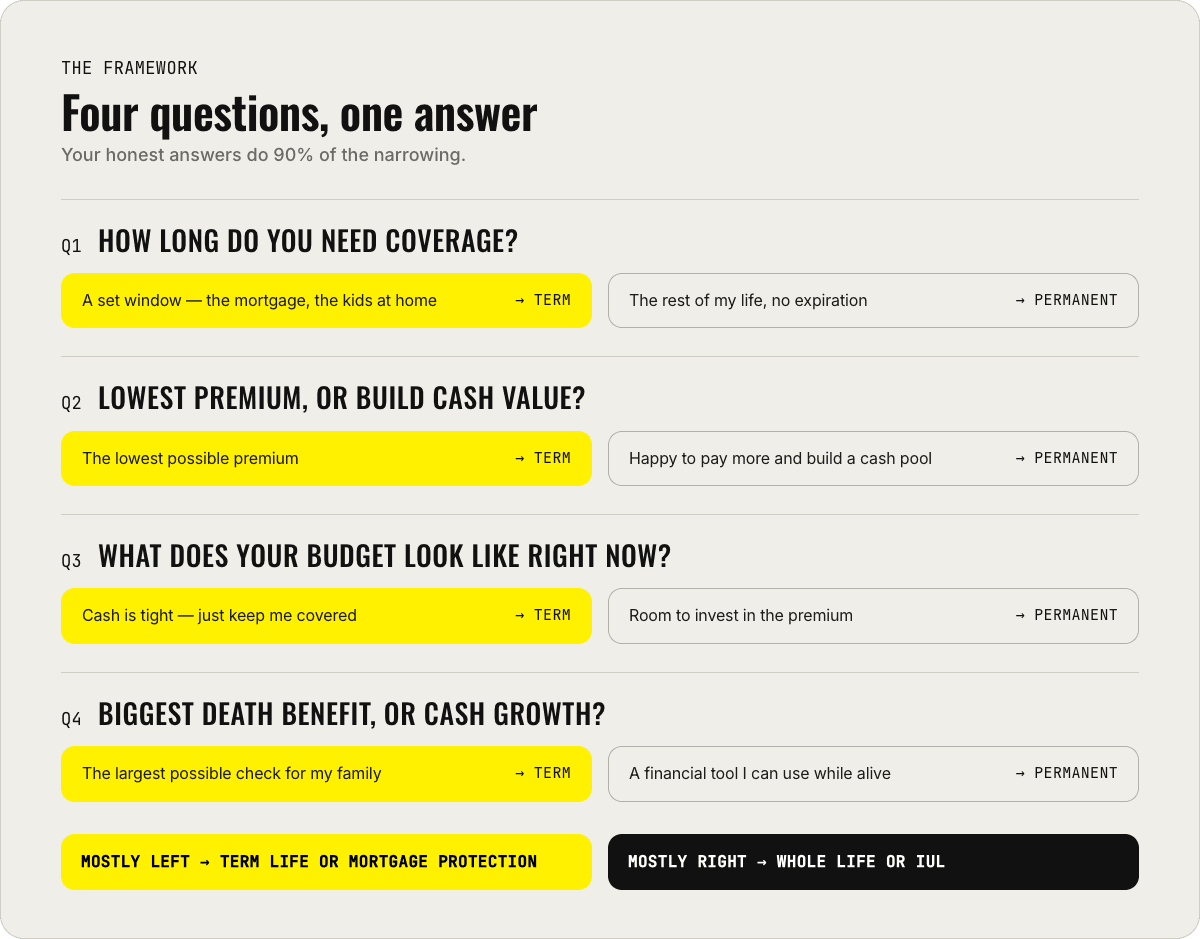
1. Do you need coverage for a specific period of time, or for the rest of your life? Think about why you need coverage. If it's tied to something with an end date — paying off a 30-year mortgage, or covering your kids until they're grown and out of the house — you're leaning term. If you want something that never expires, builds value, and can eventually help fund retirement or leave a legacy, you're leaning permanent.
2. Do you want the lowest possible premium, or are you okay paying more to build cash value? There's no wrong answer here — it's about what problem you're solving. Lowest premium = term. Building a pool of cash you can tap into later = permanent (whole life or IUL).
3. What does your budget actually look like right now? Not what you wish it looked like — what it actually is. Permanent policies cost meaningfully more per month than term for the same death benefit, because part of that premium is being set aside and invested. If cash is tight, term keeps you covered without breaking the bank, and you can generally look at adding or converting to a permanent policy later — assuming you still qualify at that point (more on conversion in a second).
4. Are you optimizing for the biggest possible death benefit, or for cash value growth? If your main goal is "I want my family to get the largest check possible if something happens to me," lean death-benefit-heavy (term, or a permanent policy structured for benefit over cash value). If your goal is "I want a financial tool I can grow and use while I'm alive," lean cash-value-heavy (whole life or IUL).
Once you've got honest answers to those four questions, here's how they map to real policy types.
The 5 Policy Types, Explained Like You're Hearing It From a Friend (Not a Salesperson)
1. Term Life Insurance — "Protection for Your Vulnerable Years"
What it is: Coverage for a set period of time — usually 10, 20, or 30 years. If you pass away during that window, your family gets the death benefit. If the term ends and you're still kicking (great news!), the coverage simply ends. No cash value, no bells, no whistles.
Best for: People who need to cover a specific risk window — young families, new homeowners, anyone whose kids will eventually grow up and become financially independent.
The upside: It's cheap. Like, surprisingly cheap. Because the insurance company is only on the hook for a limited window, and most people outlive their term, premiums are dramatically lower than permanent policies for the same amount of coverage.
The trade-off: It's temporary. There's no cash value building in the background, and once the term ends, your options are typically to let coverage lapse or renew at a much higher rate based on your new (older) age. Good news, though: most term policies include a conversion privilege, which lets you convert some or all of your coverage into a permanent policy — often without new medical underwriting — during a set window. It's a built-in safety net if your health changes and term-shopping later isn't an option anymore.
Think of it like: Renting an apartment. It does its job perfectly while you need it, but you don't own anything at the end.
2. Whole Life Insurance — "The Steady, Guaranteed Option"
What it is: Permanent coverage that lasts your entire life, paired with cash value that grows on a guaranteed schedule. Premiums are level — meaning they never go up, no matter how old you get.
Best for: People who want predictability above everything else, along with a permanent safety net and a conservative savings component.
The upside: Guarantees. A guaranteed minimum growth rate on your cash value, a guaranteed level premium, and a guaranteed death benefit. Many whole life policies also pay dividends (basically a bonus, though not guaranteed), and the cash value grows tax-deferred — you can even borrow against it tax-free, as long as the policy stays in force and isn't structured in a way that triggers MEC (Modified Endowment Contract) status. Let a policy lapse or surrender with an outstanding loan, though, and that loan can convert into taxable income — so this benefit works best when the policy is properly funded and monitored.
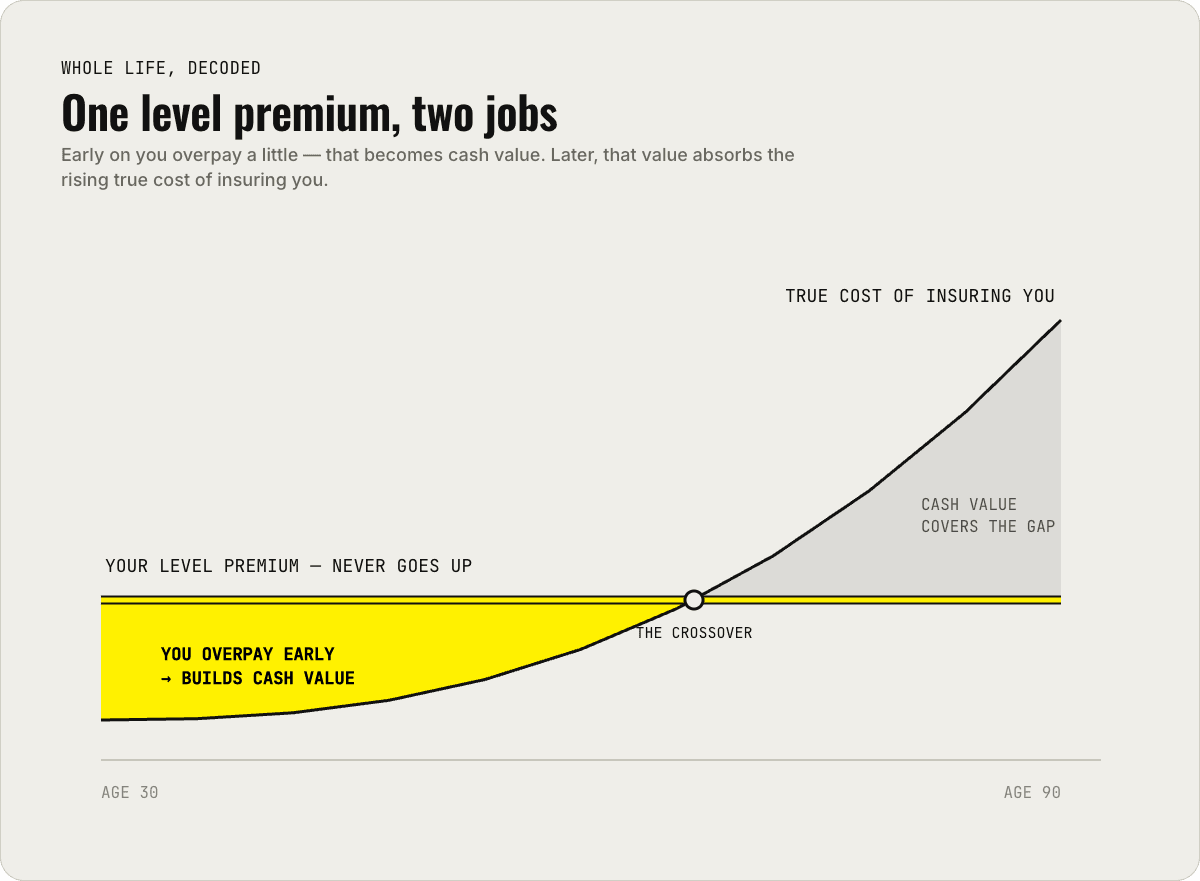
How the pricing actually works: Here's the clever part — insuring you is cheaper when you're young and more expensive as you age. Instead of your premium climbing every year as you get older (like the actual cost of insuring you would), whole life averages that cost across your projected lifetime, so you pay one level amount forever. Early on, you're actually overpaying a bit — and that overpayment is what builds your cash value.
The trade-off: Because of that averaging, whole life premiums start out higher than an equivalent term policy. You're paying more upfront in exchange for permanent coverage and guaranteed cash value growth.
Think of it like: A bond. Not flashy, doesn't swing wildly, but it grows steadily with a guaranteed floor — and it's yours forever.
3. Indexed Universal Life (IUL) — "The Growth-Focused Option"
What it is: Also permanent, also builds cash value — but instead of a fixed, conservative growth rate, your cash value's growth is linked to the performance of a market index (like the S&P 500). Note: you're not actually invested in the market — you're earning interest credits based on how that index performs, usually with a cap on the upside and a floor (often 0%) protecting you on the downside.
Best for: People who like the permanent-coverage-plus-cash-value concept of whole life, but want more upside growth potential and are comfortable with some variability year to year.
The upside: Higher growth ceiling. Because your cash value is tied to market index performance rather than a flat guaranteed rate, the potential returns can be higher than whole life over time — though caps, participation rates, and policy charges all affect what you actually end up earning, so it's not a given.
The trade-off: More risk sits with you. Returns aren't guaranteed the way whole life is — most IULs do have a 0% floor, but that floor only protects your credited interest from going negative. It doesn't protect your cash value overall: the monthly cost of insurance and other policy charges still come out regardless of how the index performs, so in a flat or 0%-crediting year, your cash value can still decline. Also worth understanding: your premium itself is flexible — you can generally pay more, less, or stick to a target amount — but the internal cost of insurance charge climbs as you get older, whether or not your premium does. The idea is that the extra growth you get while you're young outpaces those rising internal costs later in life — but that only works if the policy is funded and managed properly, and it's worth reviewing every year rather than assuming it's on autopilot.
Think of it like: A bond with a turbocharger. More potential upside, but the ride isn't always smooth, and it needs more attention over the years to keep performing the way you want.
4. Mortgage Protection Insurance — "Term Insurance With a Purpose"
What it is: At its core, this is just a term policy — but it's specifically built and sized to match your mortgage balance and payoff timeline. If something happens to you, your family isn't left trying to keep the house and grieve at the same time.
Best for: Homeowners, especially new ones, who want peace of mind that the house stays in the family no matter what.
The upside: Beyond the obvious (paying off the mortgage), many mortgage protection policies come with a living benefits rider built in — meaning if you're diagnosed with a qualifying critical, chronic, or terminal illness (and, depending on the carrier, certain injuries), you may be able to access a portion of your death benefit while you're still alive to help cover medical bills, lost income, or care costs.
The trade-off: It's still fundamentally a term product — coverage ends when the term (or mortgage) does, and there's no cash value.
Think of it like: Term life's more specialized cousin — same DNA, but purpose-built for one very specific job.
5. Final Expense Insurance — "Small, Simple, and Stress-Free"
What it is: A smaller policy — typically $5,000 to $50,000 in coverage — designed for one job: making sure funeral and burial costs don't fall on your family's shoulders. It's most common for people roughly ages 45–85, and often comes with simplified or no medical exam underwriting.
Best for: Older individuals, or anyone who wants a straightforward, low-hassle way to make sure their final expenses are handled without burdening loved ones.
The upside: Easy to qualify for, inexpensive relative to the peace of mind it buys, and dead simple (no pun intended) to understand.
The trade-off: Small coverage amount — this isn't meant to replace income or pay off a mortgage, just to cover the cost of saying goodbye properly.
What About "Riders"? (The Add-Ons)
Riders are optional add-ons that can be attached to most policy types to customize your coverage. The most common one worth knowing:
- Living Benefits Rider — lets you access some of your death benefit while you're alive if you're diagnosed with a qualifying chronic, critical, or terminal illness. Increasingly common (and increasingly expected) across term, whole life, IUL, and mortgage protection policies alike.
Think of riders like options on a car — the base model does the job, but the right add-ons make it fit your life better.
Putting It All Together: A Quick Cheat Sheet
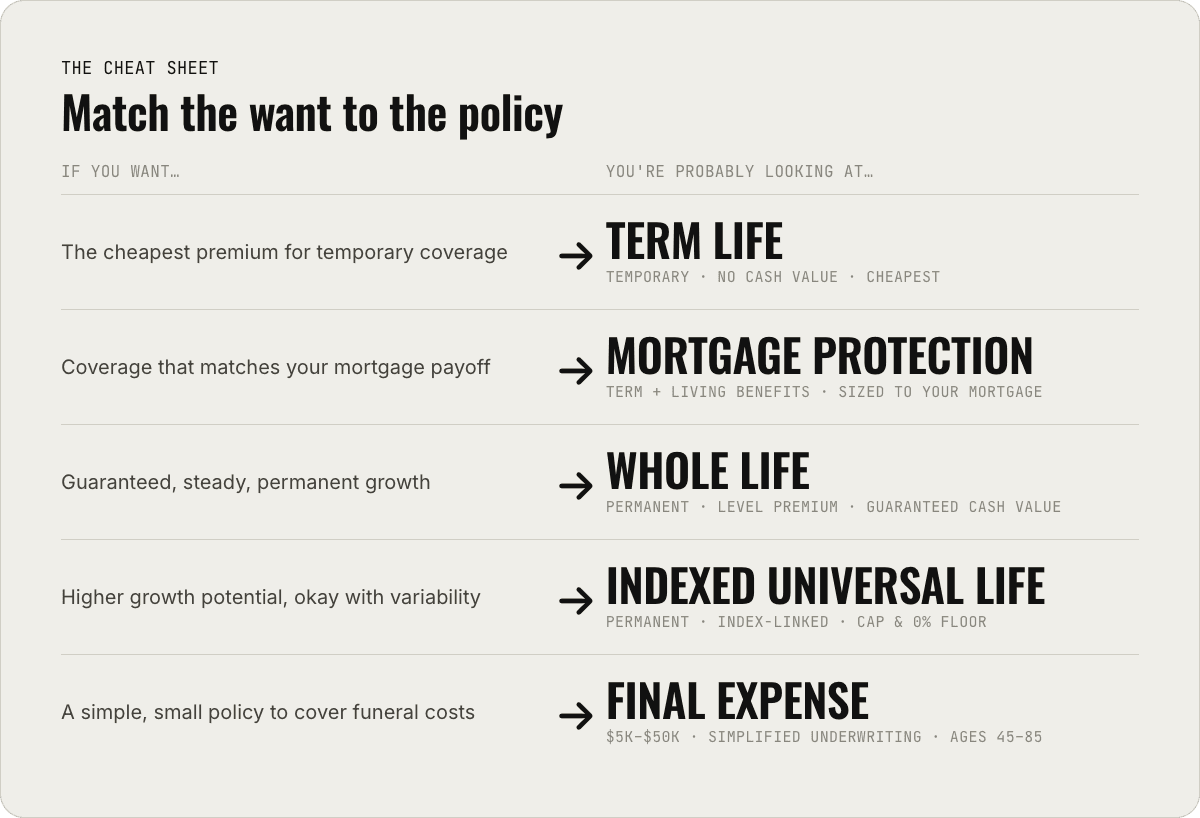
If you want...
You're probably looking at...
The cheapest possible premium for temporary coverage
Term Life
Coverage that matches your mortgage payoff
Mortgage Protection
Guaranteed, steady, permanent growth
Whole Life
Higher growth potential and you're okay with some variability
IUL
A simple, small policy to cover funeral costs
Final Expense
So... Which One Is Right for You?
If you made it this far and one of these five is already ringing a bell — good. That's the point. You don't need to know everything about life insurance to make a confident decision. You just need to know what you're solving for.
The next step is simple: take the answer you landed on, and let's find the actual policy and carrier that brings it to life at the right price for you. That's the part we handle — the comparison shopping, the fine print, the paperwork. You just tell us which category feels right, and we'll take it from there.
Ready to talk through your options? Reach out and we'll help you turn "I think I want term" (or whole life, or IUL) into an actual policy protecting the people who matter most.